
Desktop App Async Print Pipeline & Native API Interception
Printing from a modern desktop publishing application requires bridging two distinct runtime models: standard web browsers (which rely on browser-level print dialogs) and native desktop client shells (such as NW.js or Electron, which spool directly to operating system hardware drivers, generate background PDFs, and communicate with prepress production queues). Earlier builds of Open Publisher used a purely synchronous print dispatch that could block the UI thread and prevented external client shells from capturing the flattened staging DOM before system dialogs engaged. Version 4.19.10 refactored the print sequence into a robust asynchronous pipeline featuring native desktop API interception and transparent web fallback.
🖨️Asynchronous Print Pipeline Architecture & Spooler Interception
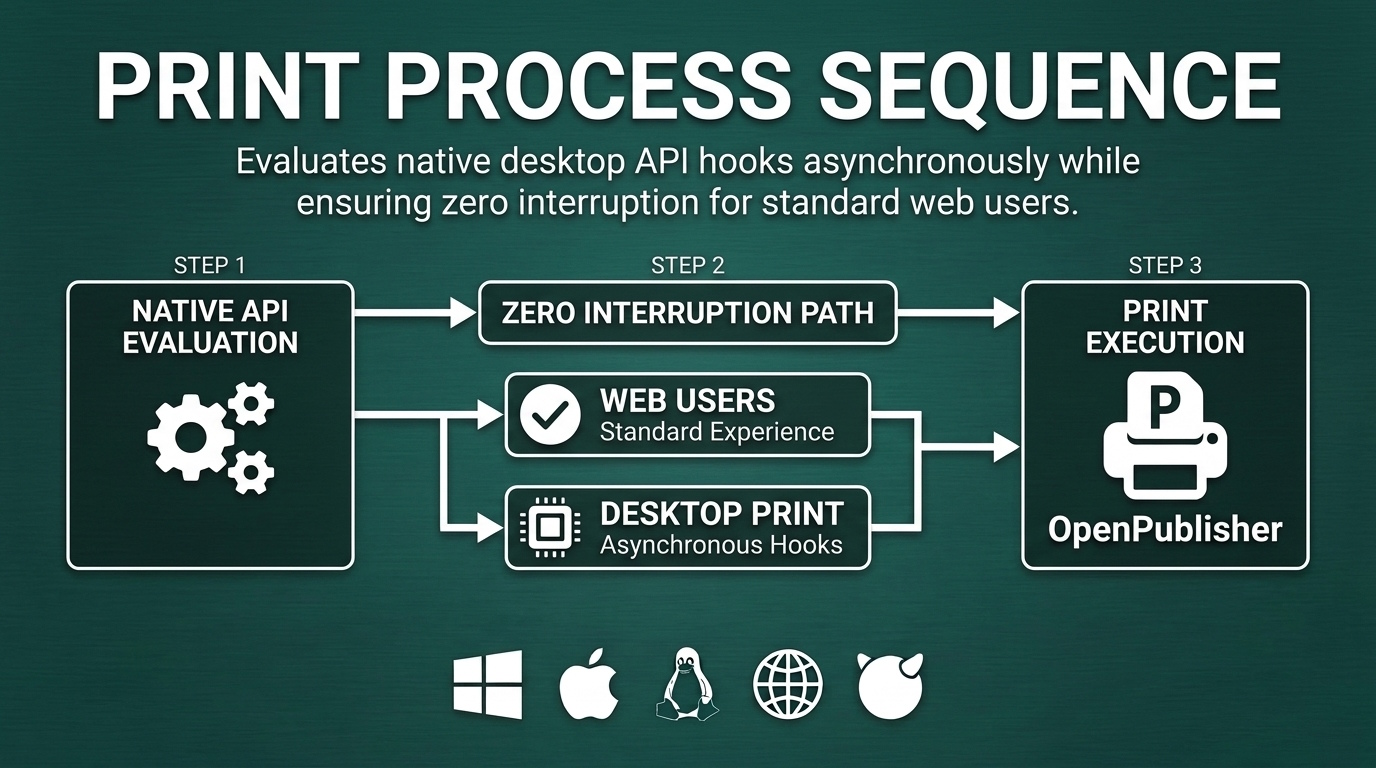
The print sequence evaluates native desktop API hooks asynchronously while ensuring zero interruption for standard web users.
Asynchronous Print Architecture in file-io.js
Version 4.19.10 modernized print execution across the codebase:
-
Async Handler Modernization: In io/file-io.js, printFullDocument() was refactored from a blocking function into a modern async routine.
-
Sequential DOM Preparation: Heavyweight pre-print operations (including font glyph harvesting, image pre-baking, CSS transform flattening, and staging iframe resolution) execute sequentially using await, preventing race conditions before print capture begins.
The OP_Desktop_API Interception Hook
To allow native wrappers to intercept and handle print jobs directly, Open Publisher introduced a dedicated runtime bridge hook:
-
API Presence Verification: In extensions/print-engine.js, the physical print engine checks whether window.OP_Desktop_API is defined in the host environment.
-
Print Pipeline Suspension: If window.OP_Desktop_API is present, the standard browser print sequence pauses and awaits window.OP_Desktop_API.triggerCustomPrint(). This gives the native desktop client complete control to capture the rendered iframe DOM, access raw postscript drivers, and route jobs to OS spoolers.
-
Iframe Resolver Interception: The Physical Print Engine iframe resolver intercepts the custom desktop API wrapper, enabling silent background PDF generation and print queue monitoring.
Transparent Web Experience & DOM Cleanup
For standard web users, the refactored pipeline guarantees zero friction:
-
Automatic Browser Fallback: If OP_Desktop_API is not detected, the system immediately invokes window.print() without hesitation.
-
Safe Synchronous Teardown: Once printing concludes or the user dismisses the print dialog, cleanup routines execute cleanly, dismantling offscreen staging iframes and reclaiming memory.
Tip: In the V5 desktop client, asynchronous printing routes directly to the Export & Print Queue Monitor in the system tray.