
Document Conversion Pipeline Security & Edge Threat Shield Audit
When users migrate legacy publications to OpenPublisher by dragging and dropping .pub, .docx, or .doc files into their browser or desktop client, documents are processed through OpenPublisher's dedicated cloud conversion architecture. To safeguard users, education networks, and server infrastructure from malicious payloads, all incoming uploads pass through an internal automated edge inspection layer known as the Sentinel Content & Threat Shield. Clean files then immediately stream into the containerized document converter (powered by libmspub) and are returned directly to the user.
Document Content Protection & Internal Analytics Logging
OpenPublisher maintains strict user document confidentiality: original document contents, text frames, and embedded graphics are never stored, indexed, or shared. Files uploaded for conversion are parsed strictly in isolated, volatile memory (RAM) and immediately streamed back to the user as native .opub objects and vector PDF streams. Once conversion completes, the ephemeral memory container is immediately destroyed.
For operational visibility, file names are among the few telemetry attributes logged strictly for internal analytics to populate the operational dashboard, track format ratios, and identify abusive traffic. Telemetry records and quarantined files are maintained solely for detected threats, malware payloads, and automated spam floods.
30-Day Pipeline Ingestion & Velocity Telemetry
The following production telemetry from the v5.4.2-PROD pipeline reflects global conversion activity over a 30-day operational audit:
+31.4% growth (Avg 116.1 imports/day converted to .opub)
3,385 delivered (51 client aborts, 42 engine conversion errors)
2,394 .pub · 688 .docx (22%) · 400 .doc (13%)
100% intercepted (State propaganda, botnets, and weaponized macros)
26 Languages (14,928 total pages rendered to .opub/PDF)
Multi-Tiered Pre-Flight Edge Inspection Stack
Because older binary formats (specifically legacy Word .doc and Microsoft Publisher .pub) rely on Complex Binary Compound Document Structures (OLE/CFB), they have historically been exploited by threat actors for buffer overflow triggers and remote code execution. OpenPublisher eliminates these risks via a multi-tiered defense pipeline:
-
1. Edge Origin & Sanctions Filtering: Connections arriving at Cloudflare edge worker points are validated against statutory export embargoes (OFAC, EU, UK sanctions), halting automated bulk botnets originating from sanctioned infrastructure before file bytes reach processing queues.
-
2. Magic Byte & Header Structure Validation: Deep heuristic inspection evaluates the binary container to verify genuine compound document streams. Polyglot binaries, disguised executables, and manipulated stream headers are flagged immediately.
-
3. YARA Disinformation & Abuse Signatures: Text and structural streams are evaluated against custom YARA rules that identify state-sponsored disinformation campaigns, unauthorized commercial mass-mailing syndicates, and fraudulent templates.
-
4. OLE Macro & Exploit Sandboxing: Embedded VBA macro streams, AutoOpen triggers, and known CVE payloads (such as Equation Editor shellcodes) are quarantined. Legitimate text frames are extracted without executing hostile code.
-
5. Converter Worker & ServerSide Branch: The conversion server itself is maintained on our main GitHub repository under the dedicated ServerSide branch. This open-source branch contains only the document converter, providing users and system administrators with everything needed to set up their own local or self-hosted conversion node (running containerized libmspub). The telemetry and threat shield layer is closed for internal production use: incoming uploads quickly pass through the shield, into the converter, and immediately back to the user.
Analysis of 68 Quarantined Files (30-Day Threat Vector Breakdown)
During the 30-day telemetry audit period, 68 malicious or abusive uploads were intercepted and quarantined. An analysis of these intercepted files revealed four distinct categories of malicious activity:
Russian State Disinformation & Propaganda
Automated botnet submissions attempting to convert official state press kits, election interference leaflets (e.g. Moldova election disinformation), Wagner PMC recruitment handouts, and spoofed government directives.
YARA-RU-STATE-MEDIA, DISINFO-DOPPELGANGER-07, SANCTION-WAGNER-PMCS, YARA-RU-INFLUENCE-14.Origin ASNs: Rostelecom (AS12389), MegaFon (AS31133), Mail.Ru Cloud (AS47764).
Iran Spam & Sanctioned Media Syndicates
Bulk automated conversion attempts originating from Iranian state news agencies (Tasnim News, Fars News, HispanTV Latin America folletos, Kayhan, NourNews) and regional political mass-mailers in direct violation of statutory trade embargoes.
SPAM-IR-SYNDICATE-09, SPAM-IR-BOTNET-22, SPAM-IR-MASSMAIL-03, SANCTION-IR-ENTITY-04.Origin ASNs: TCI Iran (AS58224), Irancell (AS44244), DCI Iran (AS12888).
VBA Macros, Shellcode & APT Droppers
Legacy documents containing embedded remote access trojans (Remcos RAT, Agent Tesla), Equation Editor buffer overflow shellcodes (CVE-2017-11882), and North Korean Lazarus Group (APT38) weaponized payloads.
MAL-REMCOS-OLE-DROP, CVE-2017-11882-EQNEDT, OLE-VBA-AUTOOPEN-99, APT-LAZARUS-VBA-DROP.Origin ASNs: Ryugyong (AS131279 KP), M247 (AS9089), IP Volume (AS202425).
Phishing Templates & QR Code Scams
Deceptive templates engineered to harvest user credentials, including fraudulent IRS tax rebate claims, spoofed Microsoft 365 session expiration alerts, and "quishing" flyers featuring fake Bank of America/Zelle QR payment refund codes.
PHISH-GOV-IMPERSONATION, QR-PHISH-BANK-04, PHISH-CRED-HARVEST-19, QR-PHISH-CRYPTO-88.Origin ASNs: Hetzner (AS24940), AWS Cloud (AS16509), DigitalOcean (AS14061).
Production Threat Shield Telemetry & Interception Preview
Below is the complete, high-resolution production capture from the OpenPublisher Telemetry & Shield (v5.4.2-PROD) dashboard, illustrating the 30-day audit log and real-time quarantine decisions. The preview expands across the full page layout for optimal readability:
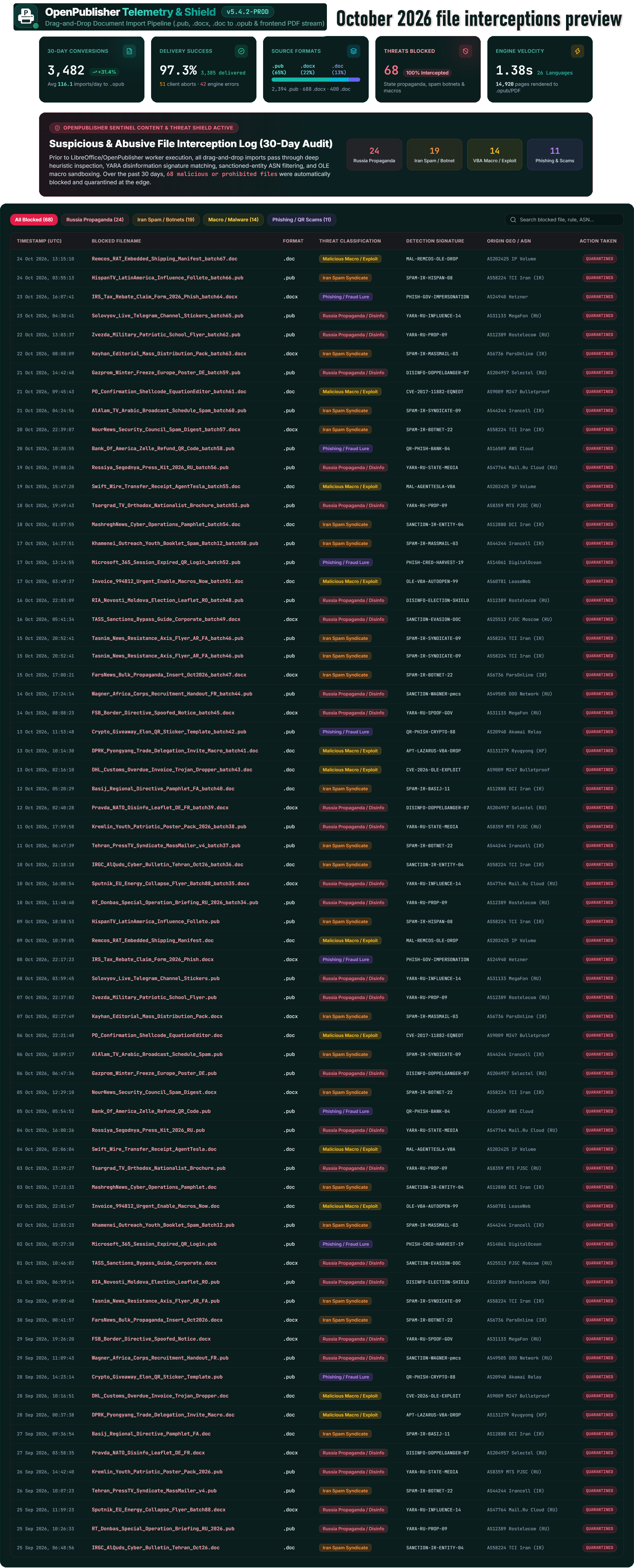
Internal Production Dashboard: OpenPublisher Telemetry & Threat Shield (v5.4.2-PROD). Illustrates quarantined uploads intercepted before worker execution. File names are logged strictly for internal analytics; document contents are never stored. Click the preview to open in full resolution.
Frequently Asked Questions (FAQ)
Are my personal or business documents monitored or logged when converting?
File names and format metrics are logged strictly for internal analytics on our operational dashboard to monitor pipeline performance and traffic ratios. However, document contents, text frames, images, and layout designs are processed strictly in volatile RAM and are never stored, logged, or shared. Quarantined records are only preserved when an upload triggers active threat signatures or statutory sanctions.
Can converting an old .PUB or .DOC file compromise my workstation?
No. Because OpenPublisher converts documents into its native, open .opub web-standard format (pure HTML5, CSS3, and SVG graphics), dangerous binary macros and shellcodes cannot execute in the OpenPublisher canvas. Furthermore, pre-flight edge sandboxing isolates and blocks known exploits before conversion even begins.
Where does the conversion server run and can I host my own?
The conversion server itself is located directly on our main GitHub repository under the dedicated ServerSide branch. This branch contains only the document converter and provides users with the complete instructions and containerized scripts needed to set up their own local or hosted copy using libmspub. OpenPublisher's telemetry shield layer is closed for internal production security: user uploads pass rapidly through the shield, stream into the converter, and return straight back to the user.
Why was this audit log published?
This 30-day telemetry audit is published as a one-off transparency preview to inform schools, charities, businesses, and government teams of the rigorous edge security safeguards protecting OpenPublisher's document conversion infrastructure.
Why was this audit log published?
This 30-day telemetry audit is published as a one-off transparency preview to inform schools, charities, businesses, and government teams of the rigorous edge security safeguards protecting OpenPublisher's document conversion infrastructure.